This is the first devlog for Reap or Rot, a real-time farming strategy I am building alone in Godot. The game is early - there is no build to download yet and no release date. But it is far enough along that it is worth describing what actually exists, rather than what I intend to make.
The world is a real place
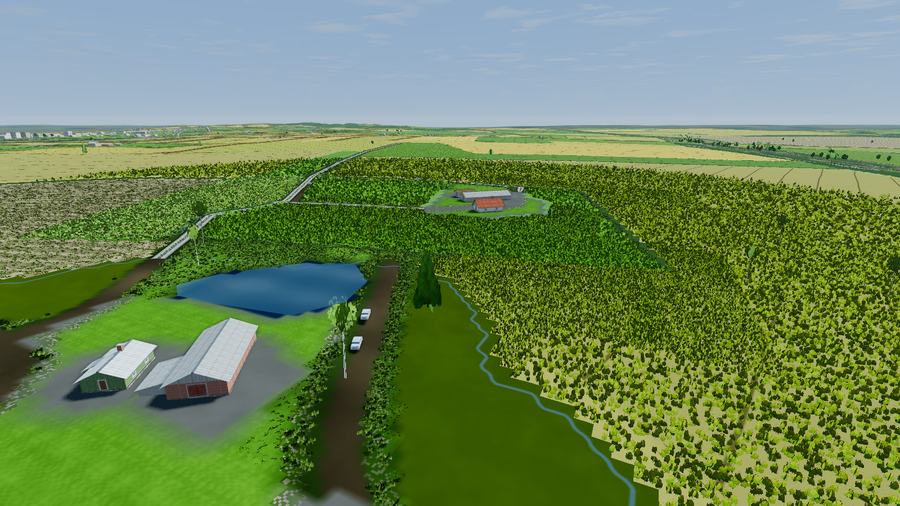
The map is 6400 x 6400 m of Pryšmančiai, Lithuania, built from open geodata: real elevation, real roads, real soil survey. That means 692 fields totalling 2 912 ha, with the field geometry taken from cadastral parcels rather than generated. The median field is 1,4 ha. The largest is 157 ha. That distribution is not a design choice I made - it is what Lithuanian land actually looks like after half a century of division, and it shapes the game more than any rule I could have written.
Roads are the same: 159,9 km in 1 012 lines - 13,9 km asphalt, 41,4 gravel, 97,4 field track - driven as a graph of 3 467 nodes.
It starts in 1991
The collective farm is still there on day one, holding 1 350 ha - 47 % of the district - with 420 cows and 34 machines. By 1993 it is gone and its land is divided. The amount of free land in the district doubles from 1 077 to 2 159 hectares, and it happens at the point where you are least able to do anything about it. That is the game.
The neighbouring farms are not decoration. They run on the same agronomy code you do - the same crop table, the same work effects, the same field states - so a neighbour's field really is ploughed in spring, sown, and combined in autumn, and you can watch it happen. Twenty years of the surrounding district simulate in 17 seconds in a headless test, and across those twenty years abandoned fields fall from 344 to 164. The landscape recovers as the farms do.
Work takes the time it takes
Job duration comes from area, implement width and speed, not from a fixed number. The same 2,64 ha field takes 7,8 hours with the starting 60 kW tractor and a two-furrow plough, and 2,7 hours with 155 kW and five furrows. That is the entire reason to want a bigger tractor, and it is also why the machinery catalogue matters: 58 tractors and 52 self-propelled machines spanning 1965 to 2026. In 1991 only 22 tractors are available to you, 19 of them period Soviet machinery.
Weather is a millimetre water balance against Lithuanian 1991-2020 norms - 670 mm of precipitation across 177 rain days. Over a forty-year average you get 18 suitable days out of 36 to sow spring crops. In a bad year, two.
Most of my work has been finding out that things I thought worked, didn't
The most useful thing I built is not a feature. It is 77 automated checks, of which 75 are green. One opens all 14 game windows and screenshots each, then measures whether the window is actually drawn. Another plays 14 unattended game years to see whether anything hangs, accumulates or collapses. Almost every check has to be proven to fail first - I break the thing deliberately and confirm the check goes red - because a check that has never failed is just a green light with nothing behind it.
They found a lot.
Every one of my 19 crops had a harvest window in the data table. A search through the source found that table and nothing else: nobody read it. Sowing worked and harvest worked - only the time between them meant nothing. You could run the combine the day after sowing and get a full yield.
Field work was being computed in two places that did not know about each other, so grain appeared in the barn at the stroke of midnight while the tractor was still out in the field, and every job that day finished at the same instant. There was also a hardcoded time scale in the machinery code that never looked at the clock at all. The fix was to make the job's duration authoritative and the moving machine its picture, so the two cannot drift apart in principle. A six-hour job now takes 24 seconds at x1, 4,8 at x5, 1,2 at x20 - measured.
In a long unattended run, three cows on a 3,5 ha farm became 1 029 animals in a fifteen-stall cowshed, because nothing was ever sold, culled, or died. In the same run the farm assistant ran out of fuel in 1992 and stood there until 2005 - four fields unworked for fourteen years, and not one word on screen. And ploughing had an empty validity list, which means valid in any state, so the assistant ploughed field 315 for twelve years straight.
None of that was visible by playing. It was visible by running the game for fourteen years with nobody at the controls and reading what came out.
What I am working on now
Almost entirely how it looks. I rebuilt one tractor from photographs of my own machine as a reference the rest of the catalogue has to match - mostly learning that a wheel needs an actual hole in it, that white paint reads as polished steel unless you warm it, and that a cab is a glass house rather than a box with bars. Machine surfaces now get mud, dust and edge paint wear computed without any UVs at all, because the old UV data turned out to be broken in a way that made every machine come out camouflage. Next: dirt that responds to the weather and to the job just finished, and the remaining machines rebuilt in order of how closely you ever see them.
After that, the world gets more alive: farmsteads that look lived in, and places you actually drive to rather than menu entries.
What is not there
No packaged build has ever been run. There is no sound - a catalogue of what is needed, and nothing recorded yet. The railway station is built but nothing runs on it. No release date, no price, no platform promises. I would rather say that now than imply otherwise.
If there is something you want in a farming game that nobody makes, the suggestions page takes posts without registration and sorts them by votes. I read all of it.